The Best Fluffy Pancakes recipe you will fall in love with. Full of tips and tricks to help you make the best pancakes.

A window energy rating is the coloured label you see on brochures and stuck to the frame of many new windows. It looks just like the energy label on a fridge, running from green A++ at the top to red at the bottom. It is genuinely useful for comparing products, but it is also widely misunderstood, and it is often used in sales conversations to suggest that perfectly good windows need replacing.
This guide explains what a window energy rating measures, how it relates to U-values, what the Building Regulations require for replacement windows in England, and what it all means if you are repairing rather than replacing.
Quick answer
A Window Energy Rating (WER) grades a whole window, frame and glass together, on a scale from A++ to E. It combines heat loss (U-value), solar heat gain (g-value) and air leakage. Since 15 June 2022, replacement windows in existing homes in England must achieve a U-value of 1.4 W/m²K or better, or a WER of band B or better. Repairs such as new glass units do not have to be re-rated.
What a window energy rating measures
The Window Energy Rating scheme was developed by the British Fenestration Rating Council (BFRC), which is owned by the glazing industry’s trade association, the Glass and Glazing Federation. Ratings are also issued through other recognised schemes, such as Certass and the BSI Kitemark scheme.
A window energy rating is not just about keeping heat in. It is an energy balance that weighs three things for a standard-sized window:
U-valueHow much heat escapes through the window. Lower is better
g-valueHow much free solar heat comes in through the glass
L-valueHow much air leaks through the window seals
Because solar gain counts in a window’s favour, two windows with the same U-value can achieve different ratings. According to BFRC, windows with an energy rating of zero or higher, which covers bands A to A++, are considered energy positive under standard conditions: over a typical year they gain at least as much useful heat as they lose.
The A++ to E scale
U-values explained in plain English
A U-value measures how quickly heat passes through a material, in watts per square metre for each degree of temperature difference (W/m²K). The lower the number, the better the insulation.
There are two U-values you may see quoted, and confusing them is common:
- Centre-pane U-value. This is the performance of the glass in the middle of the unit, away from the edges. It is always the most flattering number.
- Whole-window U-value. This includes the frame and the edge of the glass, where the spacer bar sits. It is the figure that the Building Regulations use, and it is always higher than the centre-pane figure.
If a quote highlights a very low U-value, ask whether it is centre-pane or whole-window. Our guide to replacement glass units explains how low-E coatings, gas fill and warm-edge spacers each affect performance.
What the Building Regulations require
Since April 2002, all replacement windows in England and Wales have been covered by the Building Regulations. The current standard for existing homes in England came into force on 15 June 2022 through Approved Document L. For a replacement window, the maximum U-value is 1.4 W/m²K, or the window can comply by achieving a minimum WER of band B. The previous requirement for many windows was band C.
| Work | Energy standard applies? | Certification |
|---|---|---|
| Replacing a whole window | Yes: U-value 1.4 or WER band B | Competent person scheme (e.g. FENSA, Certass) or Building Control |
| Replacing a sealed glass unit only | No, not normally building work | Not required |
| New hinges, handles, locks or gaskets | No | Not required |
| Repairing rotten sections of a frame | No, not normally building work | Not required |
The Planning Portal confirms that the regulations do not normally apply if the work is no more than replacing broken glass, rotten sashes or rotten sections of frame. Our guide to FENSA and window repairs covers certification in more detail.
Does a lower rating mean you should replace?
Not on its own. Many windows installed before 2010 were never rated, or were rated to older bands. That does not mean they are failing. A window with sound frames, intact sealed units and good seals still performs much as it did when installed.
The rating tells you how a new product compares with another new product. It does not tell you whether replacing your existing windows is worthwhile. For that, you need to compare the cost of replacement with the realistic saving. The Energy Saving Trust’s figures suggest that even moving from single glazing to A-rated double glazing in a semi saves around £85 a year in Great Britain. Our article on whether new windows save money works through the payback.
How to read a WER label
- Find the rating band at the top of the label, shown as a letter and colour.
- Check the energy index, shown in kWh per square metre per year. Higher, or less negative, is better.
- Look at the U-value for the whole window.
- Check the scheme and licence number. Genuine BFRC rated products carry an official label naming the certified company and its membership number.
- Compare like with like. Ratings are calculated for a standard window size, so use them to compare products rather than to predict your exact bills.
Repairs that improve performance without a new window
You cannot re-rate an existing window by repairing it, but you can bring its real-world performance closer to its original potential, and sometimes beyond.
- Replace failed sealed units with low-E, gas-filled units with warm-edge spacers.
- Restore the air seal by replacing worn gaskets and adjusting locking cams. Air leakage is one of the three parts of a WER.
- Fix dropped sashes so the window closes evenly against its seals.
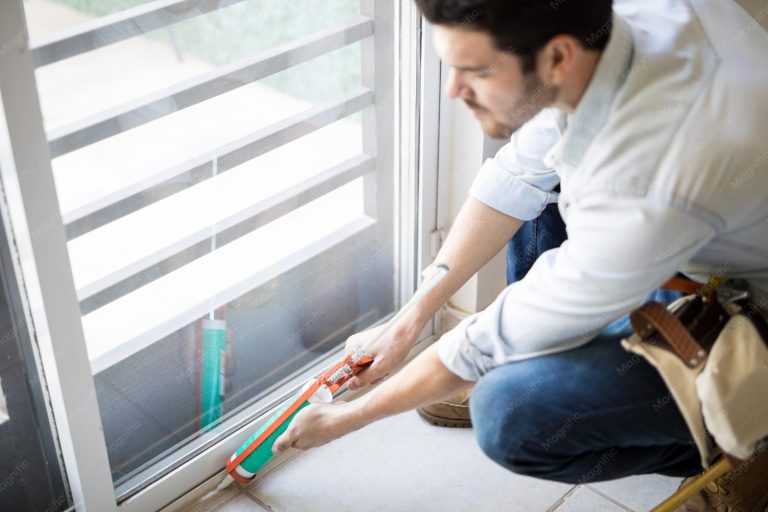
- Reseal the frame to the wall where sealant has cracked.
Our guide to fixing draughty windows explains these repairs and their costs.
Door energy ratings
Doors have a similar scheme. BFRC launched a Door Energy Rating scheme in 2011, and replacement doors must meet their own U-value requirements. As with windows, repairing a door’s locks, hinges or seals does not require it to be re-rated.
Who to ask about window energy ratings
If you are buying replacement windows, ask the installer for the window energy rating and the whole-window U-value of the exact product, plus the scheme and licence number on the label. Genuine BFRC rated products carry an official label naming the certified company. If you are keeping your windows, a repair specialist is the right person to restore their real-world performance by replacing failed units and worn seals. Our guide on choosing a window repair specialist explains what to ask.
What to watch out for
- Centre-pane U-values presented as whole-window figures. The whole-window figure is always higher.
- “Your windows are only C rated, so they must be replaced”. The rules apply to new windows, not existing ones.
- Labels without a scheme or licence number. Ask which scheme issued the rating.
- A++ upsells where the extra yearly saving over an A or B rated window is small.
How to keep your windows performing
A window energy rating describes a new product under standard conditions. Real-world performance depends on how well the window still seals. Keep gaskets clean and supple, adjust locking cams so windows close firmly, replace misted units promptly, and make sure frames are sealed to the wall. Air leakage is one of the three ingredients of a window energy rating, and it is the one homeowners can influence most. Our maintenance checklist covers the routine.
Window energy rating checklist for buyers
- Ask for the band of the exact product being quoted.
- Ask for the whole-window U-value, not just the centre-pane figure.
- Check it meets current rules: U-value 1.4 W/m²K or better, or band B or better, for replacements in England.
- Check the certification route: competent person scheme or Building Control.
Frequently asked questions
What window energy rating do I need?
For replacement windows in existing homes in England, at least band B, or a whole-window U-value of 1.4 W/m²K or better.
Is A++ worth paying extra for?
A++ windows are the most efficient, but the extra yearly saving over an A or B rated window is small for most homes. Weigh it against the price difference.
Do I need to upgrade old windows to meet current ratings?
No. The standards apply to new and replacement windows, not to existing windows that you are keeping or repairing.
Does replacing a sealed unit change my window’s rating?
The window will not be re-rated, but a modern low-E unit can improve its real performance compared with an old or failed unit.
Featured image by jannoon028 on Magnific (free licence).