
The Best Fluffy Pancakes recipe you will fall in love with. Full of tips and tricks to help you make the best pancakes.

uPVC window handle replacement is one of the simplest repairs in the whole house, yet a broken or stiff handle is often treated as a sign that the window is finished. A handle that spins, sticks, flops or will not lock usually comes down to one of two parts: the handle itself, or the gearbox inside the sash that the handle turns. Both are designed to be replaced.
This guide explains how uPVC window handles work, how to tell whether the handle or the mechanism is at fault, how to choose the right replacement, and what professional replacement costs. It also covers locking and child-safety handles, which are worth considering while you are making a change.
Quick answer
If the handle is cracked, loose or its key lock no longer works, replacing the handle alone is usually enough. If the handle turns but the window will not lock, or it spins freely, the gearbox or espagnolette mechanism inside the sash has probably failed. Typical professional repairs to handles, hinges and locks cost around £50–£150 per window, compared with £350–£600+ for a new window.
How a uPVC window handle works
Most modern uPVC casement windows use an espagnolette locking system, usually shortened to “espag”. The handle sits on the inside of the sash and has a square spindle that passes into a gearbox. When you turn the handle, the gearbox drives a metal bar running along the edge of the sash. That bar carries several locking cams, which slide behind keeps on the frame to lock the window at multiple points.
Older uPVC and aluminium windows sometimes use cockspur handles instead. These have a hooked tongue that closes over a wedge on the frame and lock at a single point. They are simpler, but replacements are still widely available.
2Screws hold most espag handles in place
43mmA very common screw-centre spacing on uPVC handles
£50–£150Typical professional handle, hinge or lock repair
Handle or gearbox? How to tell which has failed
This is the most useful diagnosis to get right, because it decides whether you need an inexpensive handle or a mechanism replacement.
| Symptom | Likely cause |
|---|---|
| Handle cracked, wobbly or the push button broken | Handle |
| Key lock in the handle will not turn, or the key is lost | Handle |
| Handle spins round without moving anything | Spindle snapped or gearbox stripped |
| Handle turns but the window stays locked or will not open | Gearbox or espag bar failed |
| Handle is very stiff only when the window is closed | Alignment or compression, not the handle |
| Handle turns but the window will not lock | Gearbox, cams or keeps |
A good check is to open the window and turn the handle while watching the locking cams on the edge of the sash. If the cams move smoothly, the gearbox is working and any stiffness when closed is an alignment issue. If the cams do not move, or only move part way, the mechanism is the problem.
When stiffness is not the handle’s fault
Many handles are replaced unnecessarily because they feel stiff. Often the handle is fine and the window has dropped, or the locking cams are binding on the keeps. Forcing a stiff handle is the quickest way to break the gearbox, so check these first.
- Lubricate the cams and keeps with a light silicone spray.
- Look for rub marks on the keeps, which show where the cams are catching.
- Check the hinges. A dropped sash puts the cams out of line. Our hinge replacement guide explains the fix.
- Check the compression. Cams adjusted too tight make the handle hard to turn. Our guide to draughty windows explains how cam adjustment works.
Choosing the right replacement handle
Handles look similar but differ in a few important measurements. Getting these right means the new handle fits first time.
- Spindle length. Measure from the base of the handle to the end of the square spindle. Too short and it will not engage the gearbox fully. Too long and the handle will not sit flat.
- Screw centres. Measure between the centres of the two fixing screws. Many uPVC espag handles use 43mm, but not all.
- Handle type. Inline handles sit straight, while offset handles are cranked to clear the frame. Use the same type as the original.
- Hand. Offset handles are often left or right handed.
- Lock and finish. Choose a locking handle if you want key security, and match the finish to your other windows.
Locking and child-safety handles
Replacing a handle is a good moment to improve security or safety. Locking handles need a key to turn, which helps stop a window being opened from outside if a pane is broken. Many insurers expect ground floor and accessible windows to have key-operated locks, so it is worth checking your policy wording.
Child-safety handles include restrictor features or push-button releases that make it harder for young children to open an upper floor window fully. Restrictor hinges are another option. For windows that may be used as an escape route, make sure any lock or restrictor can be released quickly by an adult without hunting for a key in an emergency.
How a handle is replaced
- Open the window and turn the handle to the open position.
- Reveal the screws. Many handles have a small cover at the base that swivels or slides to reveal two screws.
- Unscrew and pull the handle out together with its spindle.
- Insert the new handle with its spindle into the gearbox, in the same position.
- Fix the screws firmly, but not so hard that the handle base cracks.
- Test it several times with the window open, then closed.
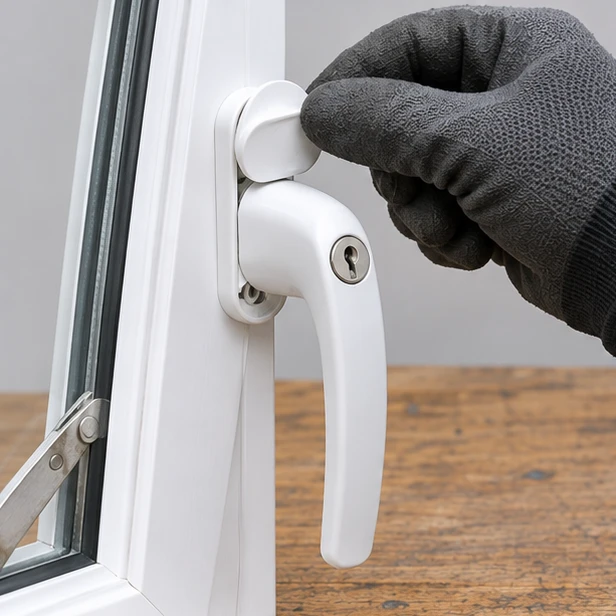 1
Turn the cover plate to reveal the screws
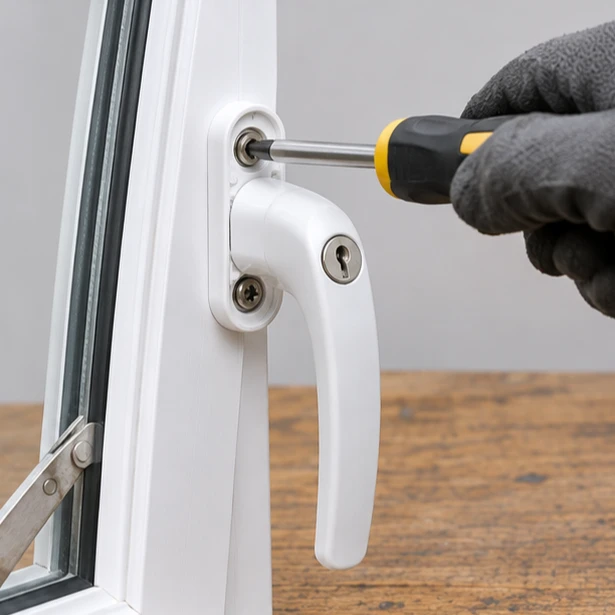 2
Undo the two fixing screws
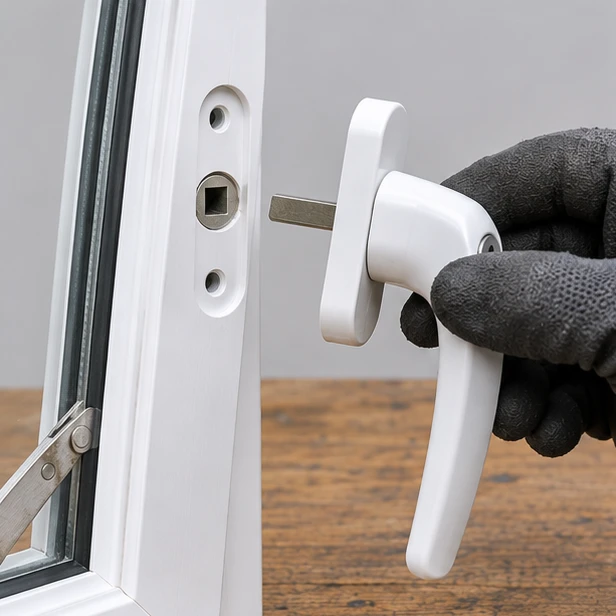 3
Pull out the old handle and spindle
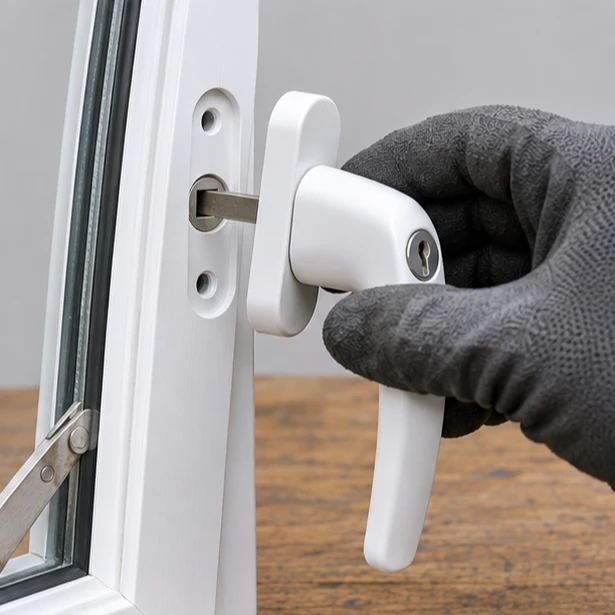 4
Fit the new handle into the gearbox
For a like-for-like handle on a ground floor window, this is a manageable DIY job. Replacing a gearbox or espag bar is more involved. The sash hardware must be removed, the correct backset and length matched, and the new mechanism fitted and adjusted.
Replacing a failed gearbox or espag mechanism
When the gearbox fails, a glazier will usually do one of two things. If the window uses a common system, the gearbox can be replaced on its own or the full espag bar swapped for a matching one. If the original hardware is obsolete, a universal or adapted mechanism may be fitted. Either way, the window stays where it is, the glass is not disturbed and the job typically takes an hour or two at most.
Do not ignore a sticking handle
A handle that needs a little extra force is an early warning. Left alone, the extra strain transfers to the gearbox, which costs more to replace than the original cause, such as a dropped sash or a tight keep. Acting early nearly always keeps the bill smaller.
It is also a security issue. A window that does not lock fully, or a handle left half-locked because it is hard to turn, is an easy target. If any window in the house cannot be locked properly, fix it before anything else.
Handles on tilt and turn windows
Tilt and turn windows use a single handle with three positions: locked, turned to open inwards like a door, and tilted to open at the top for ventilation. The mechanism is more complex than a standard espag. If the window comes off its top hinge, or will not change mode, stop and get it checked. Forcing a tilt and turn handle can unhook the sash, which is heavy and can fall inwards.
Questions to ask before you pay for a new handle
- Is it the handle or the gearbox? A clear answer shows the repairer has actually diagnosed the fault.
- Will the new handle match the others? Finish and style matter when the rest of the house has matching handles.
- Is it a locking handle? If the old one locked, the new one should too.
- Are the other windows showing the same wear? Handles of the same age often fail one after another. Replacing several in one visit saves on call-out costs.
For a complete picture of repair prices, see our 2026 repair cost guide, or our guide to uPVC doors that will not lock if the problem is on a door rather than a window.
Who to call for uPVC window handle replacement
A like-for-like handle on a ground floor window is often a simple DIY job. For gearboxes, espagnolette bars, tilt and turn mechanisms and upper floor windows, call a uPVC window and door repair specialist. Send a photo of the handle and, if possible, the edge of the sash showing the locking cams. Repairers who see the hardware in advance can often bring the right mechanism first time. See how to choose a window repair specialist.
What to watch out for
- A new handle fitted when the gearbox is the real fault. The window will still not lock properly.
- Non-locking handles replacing locking ones on accessible windows, which can matter for security and insurance.
- Forced handles. If a handle is very stiff, the cause is usually alignment, not the handle.
How to keep handles and gearboxes working
Lubricate the locking cams and keeps twice a year, so the handle turns without force. Check that sashes have not dropped, as misalignment is the main reason gearboxes fail. Always turn the handle fully to the locked position, rather than leaving it half-way. Our uPVC maintenance checklist includes these checks.
Keep reading
Frequently asked questions
Are uPVC window handles universal?
Many share common sizes, but spindle length, screw centres, inline or offset design and handing all vary. Measure the old handle before buying.
My window handle spins. Is the window broken?
Usually not. Either the spindle has snapped or the gearbox has stripped. Both can be replaced without replacing the window.
I have lost the key to my window handle. What can I do?
Many handle keys are generic and easy to replace. Alternatively, the handle can be swapped for a new locking handle.
Can a window be opened if the handle broke in the locked position?
Often yes, with care. A repairer can usually release the mechanism through the gearbox without damaging the frame.
Is uPVC window handle replacement a DIY job?
A like-for-like handle on a ground floor window is a simple DIY task. Gearboxes, espag bars and upper floor windows are better left to a professional.
Featured image by diana.grytsku on Magnific (free licence).