
The Best Fluffy Pancakes recipe you will fall in love with. Full of tips and tricks to help you make the best pancakes.

uPVC window maintenance is often sold as “maintenance-free”, which is exactly why so many windows fail early. uPVC frames do not need painting, but the parts that make a window work, such as hinges, locks, seals and drainage, still need a little attention. Half an hour once or twice a year prevents most of the faults that lead people to think their windows need replacing.
This practical checklist covers uPVC windows and doors. It explains what to clean, what to lubricate, what to check and what to leave to a professional, with a simple seasonal routine you can follow.
Quick answer
Twice a year: clean frames and gaskets with mild soapy water, clear the drainage slots, lightly lubricate hinges and locking points, and test every window and door for smooth locking and draughts. Fix small issues early. A loose hinge or stiff handle is cheap to sort; a broken gearbox or failed unit costs more.
Your uPVC window maintenance checklist
- Clean the frames with warm water and a little washing-up liquid, using a soft cloth.
- Clean the gaskets so dirt does not stop them sealing.
- Clear the drainage slots along the bottom of each frame.
- Lubricate hinges and their tracks with a light oil or silicone spray.
- Lubricate locking points such as cams, keeps, hooks and rollers.
- Check handles for looseness, and tighten screws if needed.
- Test locking on every window and door.
- Look for misting between panes.
- Check external sealant around the frames for cracks.
- Check trickle vents are clean and open.
Step 1: Clean frames, glass and gaskets
Use warm water with a little mild detergent and a soft cloth or sponge. Avoid abrasive pads, scouring creams and strong solvents, which can scratch or dull uPVC and damage rubber gaskets. Rinse and dry.
Pay particular attention to the gaskets, the rubber seals around the opening edges. Dirt and grit stop them sealing properly and wear them down faster. A clean gasket seals better and lasts longer.
Avoid pressure washers. High-pressure water can force its way past seals, damage gaskets and stress the edge seals of sealed units, which can lead to misted double glazing.
Step 2: Clear the drainage
uPVC windows are designed to let a little water in and then drain it away. Along the bottom of the outer frame you will find small slots, sometimes with flaps. If they block, water collects in the frame around the bottom edge of the glass unit, which is one of the main causes of sealed unit failure.
- Open the window and look along the bottom of the frame for the drainage channel.
- Remove debris with a soft brush or vacuum nozzle.
- Clear the slots gently with a pipe cleaner or thin plastic tool.
- Test by pouring a little water into the channel and checking it drains outside.
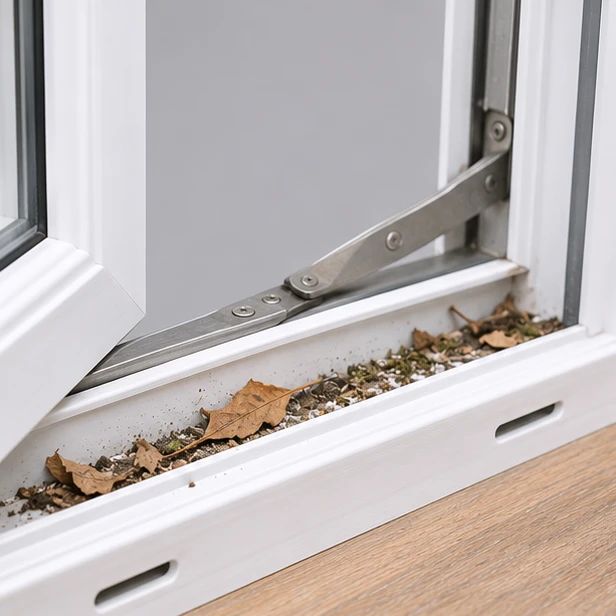 1
Open the window and look at the channel
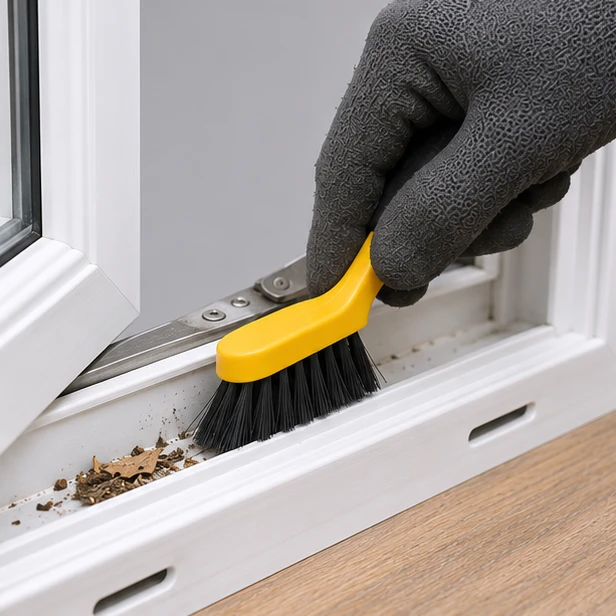 2
Brush out leaves and grit
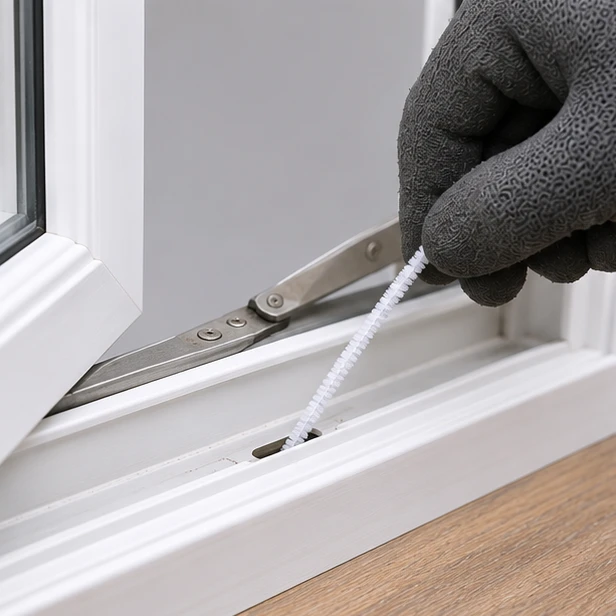 3
Clear the drainage slots
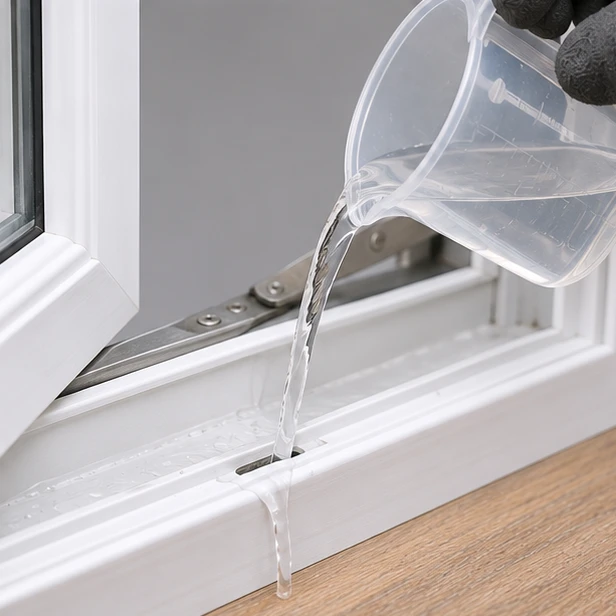 4
Pour in water to test the drainage
Step 3: Lubricate the moving parts
Hinges, locking cams, keeps and door mechanisms all benefit from a light lubricant. Use a light machine oil or silicone-based spray. Avoid heavy grease, which collects dirt, and avoid getting lubricant on the gaskets.
- Friction hinges: a little on the pivots and slider track. Our hinge guide explains how they work.
- Window locking cams and keeps: a light spray where they meet.
- Door hooks, rollers and deadbolts: lubricate along the edge of the door.
- Euro cylinders: use a lock-specific lubricant rather than oil.
Step 4: Test locking and alignment
Lock and unlock every window and door. The handle should move smoothly without forcing. If you need extra effort, something has moved. Common causes are a dropped sash on a window or a dropped door on its hinges. Catching it now avoids a broken gearbox later. See our guides to window handles and uPVC door adjustment.
Step 5: Check for draughts and misting
On a windy day, run the back of your hand around each closed window to feel for draughts. Look carefully at the glass on a cold morning for any fog between the panes. Note anything you find so that all the repairs can be done in one visit. Our guide to draughty windows explains the fixes.
Step 6: Check the outside
From the ground, or safely from inside, look at the sealant where the frames meet the walls. Cracked or missing silicone lets water and air behind the frame. Also check that sills are clear of leaves and moss and that water runs off them freely.
A seasonal maintenance routine
| When | What to do | Time |
|---|---|---|
| Spring | Clean frames and gaskets, clear drainage, lubricate, test locks | About 30 minutes |
| Early summer | Check doors in warm weather for binding caused by expansion | 5 minutes |
| Early autumn | Repeat the full checklist, check for draughts and misting, book any repairs before winter | About 30 minutes |
| Winter | Keep trickle vents open, wipe indoor condensation, watch for doors that swell or stick | Ongoing |
What not to do
- Do not paint uPVC with ordinary paint. If you want a colour change, use a specialist uPVC coating service.
- Do not seal trickle vents permanently. They control condensation and mould.
- Do not force stiff handles. Find out why they are stiff first.
- Do not drill into frames to fit blinds without checking where the reinforcement and mechanisms run.
- Do not use foam draught strip on uPVC windows; it can stop them locking.
When to call a professional
Routine maintenance is a DIY job. Call a repairer if you find:
- Misting between the panes
- A window or door that drops, rubs or will not lock smoothly after lubrication
- A handle that spins, flops or will not turn
- Bent, rusted or loose hinges
- Persistent draughts after cleaning and adjustment
- Cracks in frames or around the corners
Our repair cost guide shows what typical repairs cost in 2026.
Why maintenance saves money
The difference between a well-kept window and a neglected one is not cosmetic. Blocked drainage shortens the life of sealed units. Unlubricated hinges wear faster. Forced handles break gearboxes. Each of those failures costs far more than the half hour it takes to prevent them. Regular maintenance can also help keep a guarantee valid, so check your guarantee terms.
uPVC window maintenance: who to call when the checks find a problem
Routine uPVC window maintenance often turns up small faults: a hinge that is starting to sag, a handle that needs extra force, a misted pane or a door that has dropped. Make a list as you go, with photos, and book one visit from a window and door repair specialist to deal with everything. For locks, a locksmith may be the better choice, and for timber sash windows a sash specialist. See how to choose a window repair specialist.
What to watch out for during your checks
- Water sitting in the bottom of the frame after rain, a sign of blocked drainage.
- Black mould on gaskets or sills, which points to condensation and poor ventilation.
- Rust on hinges or keeps. Lubricate them, and plan replacements if they are badly corroded.
- Cracked corners on frames, which need a professional opinion.
- Hairline cracks in glass or a chipped edge on a sealed unit, which can lead to failure.
Your uPVC window maintenance kit
You do not need much. A soft cloth and sponge, a bucket of warm water with mild washing-up liquid, a soft brush or vacuum nozzle for tracks and drainage, a pipe cleaner for drainage slots, light machine oil or silicone spray, a lock lubricant for cylinders, and an Allen key set for cam adjustment. Keep them together so the twice-yearly check takes half an hour rather than an afternoon.
Maintenance mistakes that cause repairs
- Using abrasive cleaners that dull frames and damage gaskets.
- Greasing hinges heavily, which attracts grit and wears them faster.
- Pressure washing around sealed units.
- Painting over seals or trickle vents.
- Ignoring stiffness until a gearbox breaks.
Keep reading
Frequently asked questions
How often should uPVC windows be maintained?
A full check twice a year, in spring and autumn, is enough for most homes, with a quick wipe of indoor condensation in winter.
What is the best lubricant for uPVC windows?
A light machine oil or silicone spray for hinges and locking points, and a dedicated lock lubricant for cylinders. Avoid heavy grease.
Can I clean uPVC with bleach?
It is best avoided. Mild detergent and water are enough for routine cleaning and will not damage the frames or seals.
Do uPVC windows need servicing?
They benefit from simple routine care. A professional service is worth booking if several windows are stiff, draughty or hard to lock.
Featured image by magnific on Magnific (free licence).