The Best Fluffy Pancakes recipe you will fall in love with. Full of tips and tricks to help you make the best pancakes.

uPVC door adjustment is the most underrated repair in home maintenance. A door that scrapes the threshold, catches at the top corner, lets in a draught or needs a shoulder barge before it will lock has almost always dropped on its hinges. It has not “failed”. In many cases a few precise turns of an Allen key on the hinges put it back where it belongs, and the problems disappear.
This guide explains why uPVC doors drop, how to read the gaps to see which way a door has moved, how the three main types of door hinge are adjusted, and when it is time to call a professional. It also explains the hidden cause of many repeat drops: glass that has slipped inside the door panel.
Quick answer
Most uPVC doors that stick, scrape or will not lock have dropped slightly on their hinges. Adjustable flag and butt hinges can usually be corrected with an Allen key, lifting the door and moving it sideways or towards the seals. If the door keeps dropping, the glass or panel inside it may need repacking. Simple adjustments often fall within a repairer’s call-out charge.
Why uPVC doors drop
A uPVC door is heavy, especially with a large double glazed panel, and all that weight hangs from the hinge side. Over time, several things let the door sag towards the lock side:
- Hinge wear. Every opening puts load on the hinges, and the adjustment settings can creep.
- Slipped glazing. The glass or panel sits on small plastic packers inside the door. If they move or were badly placed, the door sash loses its shape and the lock corner drops.
- Slamming. Doors that are slammed or left to swing open in the wind take repeated shocks.
- Heat. uPVC expands in warm weather, which can make a borderline door suddenly tight in summer.
- Heavy additions. Letterplates, knockers and door chains add weight on the wrong side.
Read the gaps before you touch anything
With the door closed, look at the gap between the door and the frame on all four sides. The pattern tells you which way it has moved.
| What you see | What it means | Adjustment needed |
|---|---|---|
| Gap wider at the top on the lock side, tight at the bottom | Door has dropped on the lock side | Lift the door and move it towards the hinge side at the top |
| Door scrapes the threshold | Door has dropped overall | Lift the door vertically |
| Hooks catch the keeps when locking | Locking points too low | Lift the door, then fine-tune keeps |
| Draught along the hinge side | Door not pulled in on its seals | Adjust compression on the hinges |
| Door rubs the frame on the lock side | Door sitting too far over | Move it laterally towards the hinges |
The three main types of uPVC door hinge
Flag hinges
Flag hinges are the most common on uPVC doors. Each hinge has a “flag” attached to the frame and a matching part on the door, with a pin between them. Most flag hinges can be adjusted in three directions, usually with a 4mm or 5mm Allen key:
- Vertical. A screw in the top or bottom of the hinge raises or lowers the door.
- Lateral. A screw on the side of the hinge moves the door towards or away from the hinge side of the frame.
- Compression. A cam or screw moves the door in or out against the seals, which controls draughts and locking pressure.
Butt hinges
Adjustable butt hinges look like traditional door hinges but have adjustment screws, often hidden under caps. They usually offer lateral and compression adjustment, and sometimes vertical.
Concealed and specialist hinges
Some newer doors use hinges hidden inside the door edge, while others have hinge systems specific to a manufacturer. These can be adjusted too, but the method varies, so check the manufacturer’s guidance or call a repairer.
Adjusting a dropped uPVC door, step by step
This is the general approach for flag hinges. Make small adjustments, test often, and make the same change on every hinge unless you are deliberately correcting a twist.
- Open the door and support its weight on the lock side, ideally with someone helping.
- Remove any hinge caps to reveal the adjustment screws.
- Lift the door with the vertical adjustment, a quarter turn at a time on each hinge.
- Move it laterally if the top lock-side corner still catches, adjusting the top hinge more than the bottom.
- Close and test. Lift the handle and turn the key. Check the gaps again.
- Set compression so the door closes firmly against its seals without needing force to lock.
- Refit the caps and lubricate the hinges and locking points.
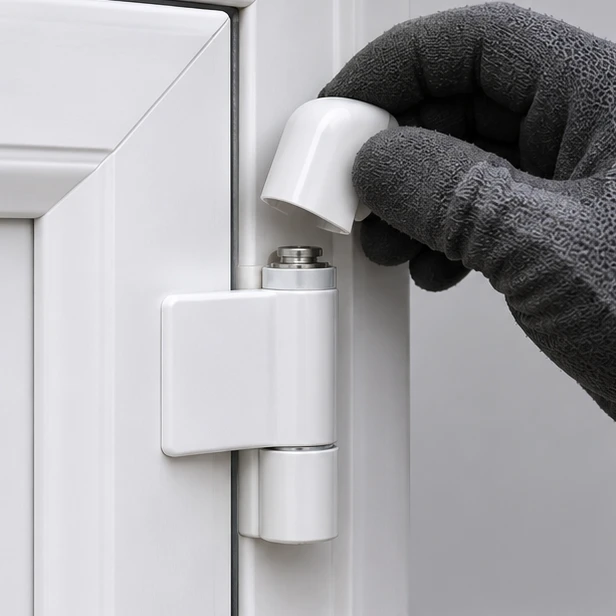 1
Remove the hinge cap
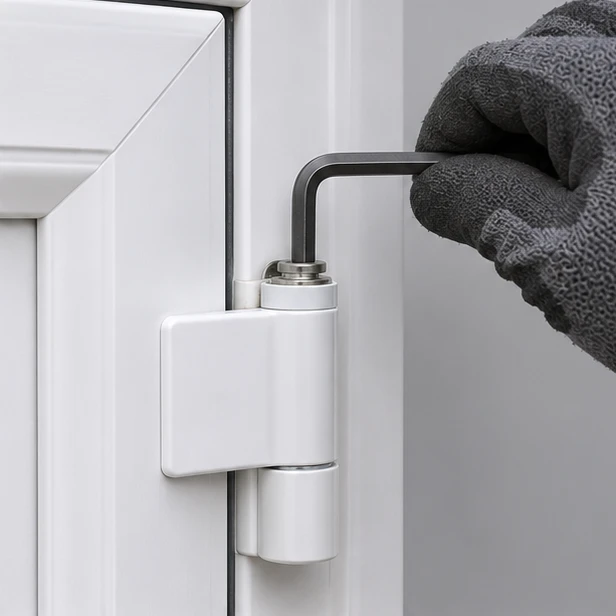 2
Lift the door with the vertical adjuster
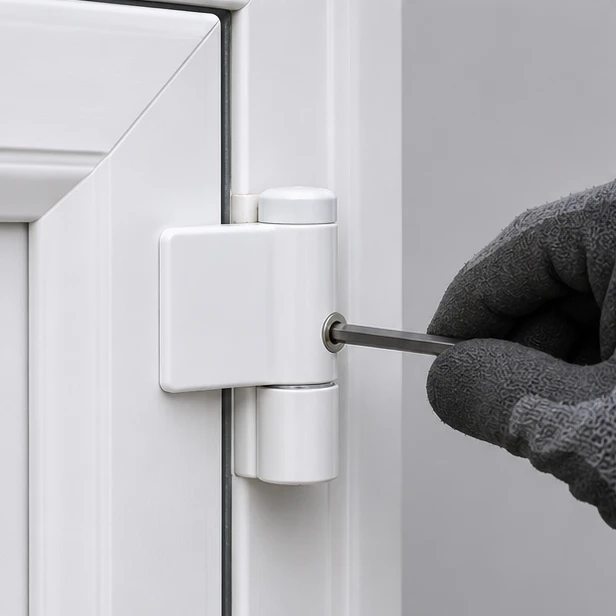 3
Move it sideways with the lateral adjuster
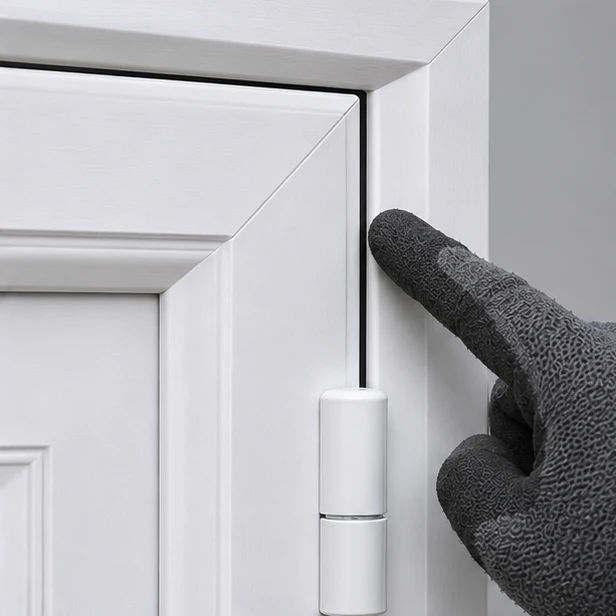 4
Close and check for an even gap
Stop if it does not move. If a hinge screw will not turn, or the door does not respond to adjustment, do not force it. A seized hinge or a door that has bowed needs a professional. Forcing it can strip the screw or crack the hinge.
When adjustment is not enough: repacking the glass
If a door drops again within weeks, the hinges are usually not the real problem. Inside the door, the glass or panel sits on small plastic packers. Correctly placed packers transfer the weight of the glass diagonally to the hinge side, holding the door square. If they slip, the door sags at the lock corner, no matter how often the hinges are adjusted.
Repacking involves removing the glazing beads, lifting the glass slightly, positioning packers correctly and refitting the beads. It is a routine glazier’s job, and it often solves a door that has been “adjusted” many times.
What a professional uPVC door adjustment costs
Because adjustment is quick, it is often covered by a repairer’s minimum call-out. If parts are needed, these are typical 2026 ranges:
| Work | Typical cost |
|---|---|
| Hinge and keep adjustment | Often within a call-out of £80–£150 |
| Euro cylinder replacement | £75–£140 |
| Multipoint mechanism replacement | £150–£350 |
| Composite door dropped hinge repair | £70–£190 |
| New front door, supplied and fitted, for comparison | £550–£1,500 |
Ranges from 2026 UK trade and locksmith price guides, rounded.
Adjustment and locking problems go together
A dropped door is the number one reason a uPVC door will not lock. The hooks and rollers on the edge of the door end up below the keeps, so the handle meets resistance. If your door is hard to lock, read our guide to uPVC doors that won’t lock alongside this one.
Leaving a dropped door unadjusted also wears the gearbox, because you have to force the handle every day. A gearbox replacement costs far more than an adjustment, so it pays to act early.
Seasonal checks
uPVC moves with temperature. A door that is perfect in winter may bind on a hot summer afternoon, especially if it faces south or is a dark colour. Two quick checks a year, in late spring and early autumn, catch most problems before they become annoying:
- Check the gaps around the closed door.
- Lock and unlock slowly and feel for resistance.
- Lubricate the hinges, hooks, rollers and keeps.
- Clean the threshold drainage so water cannot pool.
Our full uPVC window and door maintenance checklist covers everything else.
Composite and French doors
Composite doors are adjusted in much the same way, though they are heavier and some use different hinges. French doors have two leaves, and the slave leaf must be fully bolted top and bottom before the master leaf can lock properly. See our composite door repair guide for more.
Who to call for uPVC door adjustment
A uPVC window and door repair specialist or a locksmith who works on multipoint doors can usually adjust a dropped door in a single visit, and repack the glass if that is the cause. If the door also needs a new cylinder or mechanism, the same person can normally fit it. For composite doors, check that the repairer is familiar with your door’s hinge system. Our guide on choosing a window repair specialist explains who to call for each fault.
What to watch out for
- A new door recommended for a door that has simply dropped.
- Repeated adjustments without anyone checking the glazing packers inside the door.
- Forced locking. If you have to lift hard or shoulder the door to lock it, the gearbox is under strain and should be checked soon.
How to stop your door dropping again
- Do not slam the door or let it swing open in the wind.
- Avoid hanging heavy items on the lock side of the door.
- Lubricate hinges and locking points in spring and autumn.
- Check the gaps around the door twice a year and adjust early.
Our uPVC maintenance checklist includes doors as well as windows.
Keep reading
Frequently asked questions
What tool do I need to adjust a uPVC door?
Usually a 4mm or 5mm Allen key for flag hinges, and a screwdriver for hinge caps and keeps. Check your hinge type first.
Why does my uPVC door keep dropping?
If it drops again soon after adjustment, the glass or panel has probably slipped on its packers. Repacking fixes the cause.
Can adjusting the hinges fix a draught?
Often yes. Compression adjustment pulls the door tighter against its seals. If the seals are worn, they may also need replacing.
Is uPVC door adjustment a DIY job?
Small hinge adjustments are manageable for a careful DIYer. Repacking glass, seized hinges and bowed doors are better left to a professional.
Featured image by chandlervid85 on Magnific (free licence).