The Best Fluffy Pancakes recipe you will fall in love with. Full of tips and tricks to help you make the best pancakes.

Sliding patio door repair is usually far simpler than the symptoms suggest. A door that judders, grinds, jumps off its track, needs two hands to move or will not lock properly sounds like a door at the end of its life. In most cases, the cause is worn or poorly adjusted rollers, a dirty or damaged track, or a lock that no longer lines up. All three can be fixed without replacing the door.
This guide explains how a sliding patio door works, the common faults and their fixes, what you can safely do yourself, and when to call a repairer. It also covers security checks, because a sliding door that does not lock or lift properly is a weak point in a home.
Quick answer
A heavy, noisy or sticking sliding patio door usually needs its track cleaned and its rollers adjusted or replaced. Locks that will not engage often need the keep realigned. Replacing a patio door typically costs around £2,000–£4,000, so a repair at typical labour rates of around £40 an hour plus parts is nearly always the better first step.
How a sliding patio door works
Most uPVC and aluminium sliding patio doors have one fixed pane and one sliding sash. The sliding sash sits on small wheels, called rollers or carriages, fixed into its bottom edge. These run along a raised rail or track in the threshold. At the top, the sash is guided by a channel in the head of the frame.
The rollers carry the entire weight of a large double glazed panel. When they wear, seize or drop, the door drags on the track. Many roller systems have adjustment screws, usually reached through holes in the bottom edge of the sash, which raise or lower the door.
£2,000–£4,000Typical patio door replacement cost
~£40/hrTypical patio door repairer labour rate
20–30 yrsLifespan of a well-maintained patio door
Common sliding patio door problems
| Symptom | Likely cause | Typical fix |
|---|---|---|
| Heavy to slide, grinding or juddering | Dirty track or worn rollers | Clean track, adjust or replace rollers |
| Door scrapes along the bottom | Rollers worn or set too low | Raise or replace rollers |
| Door jumps or comes off the track | Damaged track or rollers, missing anti-lift blocks | Repair track, new rollers, refit anti-lift blocks |
| Lock will not engage | Door has dropped or keep is misaligned | Adjust rollers, realign keep |
| Gap at the top or side when closed | Door not level or rollers uneven | Adjust rollers on each side |
| Draught or water ingress | Worn brush seals or blocked drainage | New seals, clear drainage |
| Misting between the panes | Failed sealed unit | Replace the sealed unit |
Step 1: Clean the track
A surprising number of “broken” patio doors are simply dirty. Grit, leaves, pet hair and dead insects build up in the track and act like a brake.
- Open the door fully and vacuum the track with a narrow nozzle.
- Scrub the rail with warm soapy water and an old toothbrush.
- Clear the drainage slots in the threshold so water can escape.
- Dry the track and apply a light silicone spray. Avoid oil or grease, which attract dirt.
- Slide the door through its full travel several times.
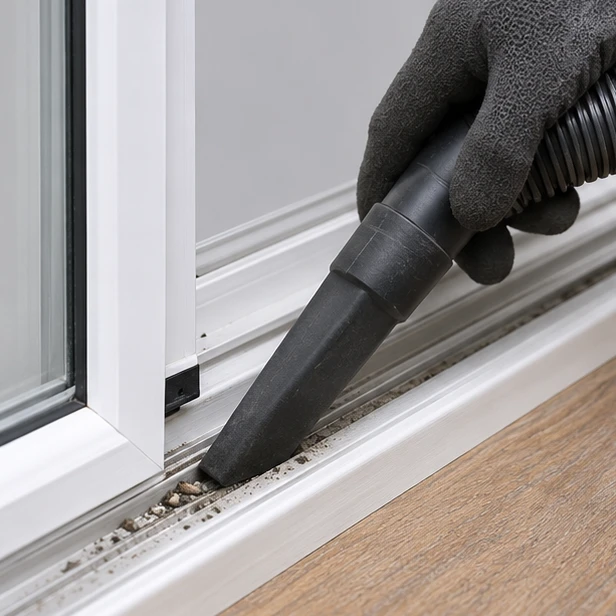 1
Vacuum the grit out of the track
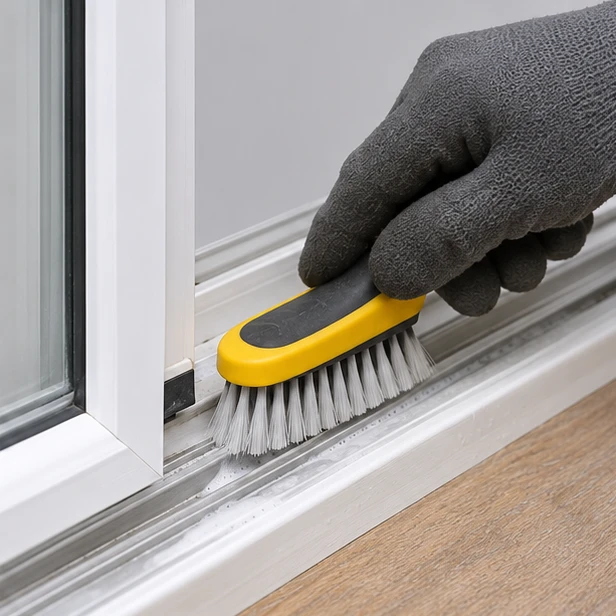 2
Scrub the rail with a stiff brush
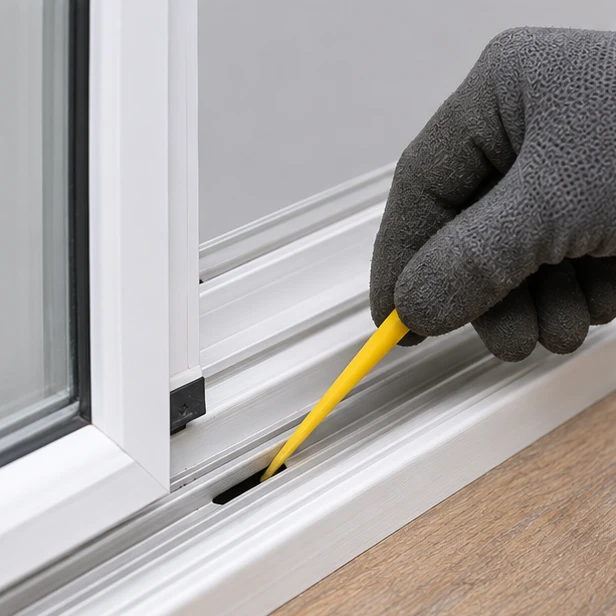 3
Clear the drainage slots
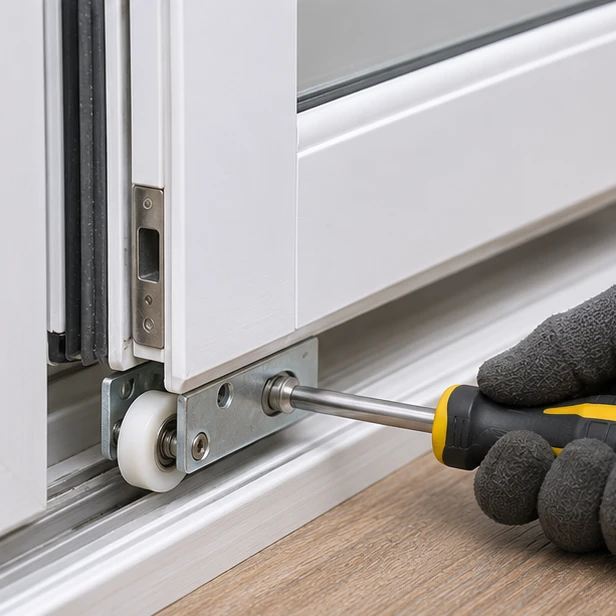 4
Still dragging? Fit new rollers
Step 2: Check and adjust the rollers
If the door is still heavy after cleaning, look at the gap between the bottom of the sash and the threshold. If it is tight or uneven, the rollers need attention. On many doors there are adjustment screws in the end or bottom edge of the sliding sash, sometimes behind small caps.
Turning the screws raises or lowers each end of the door. Adjust both ends evenly unless you are correcting a door that is out of level. Because the sash is heavy and the screws can be stiff, many homeowners prefer to leave this to a repairer.
Do not lift the sash out yourself. A large double glazed sliding panel is very heavy and awkward. Lifting it off the track to change rollers is a two-person job for someone who knows the system. Dropping it can cause serious injury and break the glass.
Step 3: Replace worn rollers
Rollers wear out after years of carrying the door’s weight. Signs include flat spots, cracked wheels, seized bearings or a door that will not lift even at maximum adjustment. Replacement involves removing the sash, swapping the roller carriages for matching ones, refitting and adjusting. Matching the rollers to the door system is important, as there are many different designs.
Step 4: Fix the track
If the track itself is dented or worn, the rollers will bump over the damage. Minor damage can sometimes be dressed out. On some doors, a replacement track cover or cap can be fitted over a worn rail to give the rollers a smooth surface again.
Step 5: Realign the lock
Sliding doors often use hook locks or multipoint mechanisms that engage keeps in the frame. If the door has dropped, the hooks miss the keeps. Adjusting the rollers often fixes this. If not, the keeps can be moved, or a worn lock mechanism or cylinder replaced. For more on cylinders, see our guide to uPVC doors that will not lock.
Security checks for sliding doors
Sliding doors can be vulnerable if they are poorly adjusted. Make sure:
- The lock engages fully every time, with no forcing.
- Anti-lift blocks are present in the head of the frame, so the sliding sash cannot be lifted off its track from outside.
- The cylinder is anti-snap rated to TS007 3-star or Sold Secure Diamond if the door has a euro cylinder.
- The sliding sash is on the inside on most designs, which helps prevent it being removed from outside.
Patio door repair vs replacement
Repair is the right choice when the frame is sound and square. Replacement is worth considering if the frame is warped, the door system is so old that parts cannot be sourced, or the threshold has been badly damaged. For the wider question, see should I replace my windows?
Misted patio door glass
Patio door panels are large sealed units, so misting is common. As with windows, the glass unit can be replaced without replacing the door. Large panels must be made from toughened safety glass, so the replacement unit will be specified accordingly. Our misted double glazing guide explains the process.
Keeping a patio door running smoothly
- Vacuum the track monthly in autumn when leaves blow in.
- Clean and lightly lubricate the track twice a year.
- Check the brush seals and replace them when flattened.
- Do not slam the door against its end stops.
- Keep the drainage slots clear to avoid water pooling in the threshold.
Our maintenance checklist covers windows and other doors too.
Who to call for sliding patio door repair
For sliding patio door repair, look for a door repair specialist who works on inline sliding systems, rather than a general handyman. Removing and refitting a heavy sliding sash safely needs experience and usually two people. Before the visit, photograph the bottom edge of the sliding panel, the track and any labels on the frame, which help identify the roller system. Our guide on choosing a window repair specialist covers what to ask.
What to watch out for
- A new door recommended for worn rollers or a dirty track.
- Missing anti-lift blocks after a repair. Ask the repairer to confirm they are fitted.
- Oil or grease on the track, which attracts dirt and makes the problem return.
- Rollers that do not match the system, which can leave the door uneven.
Sliding patio door repair and care plan
- Monthly in autumn: vacuum leaves and grit out of the track.
- Twice a year: clean the track, dry it and apply a light silicone spray.
- Each spring: check brush seals and the lock, and clear the threshold drainage.
- At the first sign of juddering: book a roller check before the wheels wear flat.
A little care keeps sliding patio door repair to an occasional roller adjustment rather than a major job.
Keep reading
Frequently asked questions
Why is my sliding patio door so hard to open?
Usually a dirty track or worn rollers. Clean the track first; if it is still heavy, the rollers need adjusting or replacing.
Can patio door rollers be replaced?
Yes. The sash is lifted out, the roller carriages are swapped for matching ones and the door is refitted and adjusted.
What should I use to lubricate a patio door track?
A silicone spray on a clean, dry track. Avoid oil and grease, which collect dirt.
How long do sliding patio doors last?
A well-maintained uPVC or aluminium patio door can last 20 to 30 years, with rollers and seals replaced along the way.
Featured image by magnific on Magnific (free licence).